
Metallography

La metallografia è una disciplina essenziale per garantire la qualità e l’affidabilità dei materiali nei settori industriale, aerospaziale e automotive. In attesa dell’apertura a Dubai, APM si pone come riferimento tecnico strategico per l’esecuzione di test metallurgici di elevata precisione per il mercato degli Emirati Arabi Uniti.
In sinergia con il nostro laboratorio d’eccellenza in Italia, forniamo dati critici per lo sviluppo, la verifica e la diagnostica di materiali metallici e delle loro leghe. Il nostro team garantisce una consulenza tecnica qualificata e una gestione dei progetti rigorosa, assicurando che le aziende degli UAE ricevano analisi metallografiche avanzate conformi ai più elevati standard internazionali.
Metallography: Structural Analysis and Advanced Material Diagnostics
Selecting a metal alloy for a specific application cannot rely solely on theoretical data. During manufacturing, a material’s characteristics can undergo significant changes that alter its performance. Variations in grain size, carbide distribution, or the presence of non-metallic inclusions can compromise strength, durability, and reliability.


Metallographic structure analysis is a critical step for industrial sectors across the UAE, including automotive, aerospace, engineering, and high-precision manufacturing. Every stage of the production cycle—from casting to heat treatment—influences the final properties. Our Italian technical coordination, supported by the analytical precision of our Italian laboratory, enables you to:
- Identify Microstructure: Highlighting any non-conformities or structural anomalies.
- Determine Grain Size: Measuring ferritic and austenitic grain sizes, essential for evaluating mechanical strength and ductility.
- Validate Treatments: Assessing the effectiveness of heat treatments and mechanical processing.
- Analyze Casting Defects: Detecting segregations, porosities, and casting flaws to ensure product excellence.
- Measure Coating Thickness: Verifying the uniformity and depth of galvanic coatings such as chrome, nickel, and zinc plating.
Heat Treatments and Material Characterization
Beyond microstructure analysis, metallography is the primary tool for validating the effectiveness of heat treatments, which are crucial for achieving properties such as strength, hardness, and wear resistance.
Pending our Dubai opening, we offer a specialized service for monitoring surface hardening treatments and galvanic layers. By coordinating high-precision evaluations at our laboratory in Italy, we ensure your materials achieve and maintain optimal performance in the demanding operating conditions of the UAE. Our analysis provides the scientific evidence that heat treatment cycles have correctly transformed the material’s internal architecture to meet design specifications.
International Reference Standards
The reliability of metallurgical tests is defined by adherence to rigorous international protocols. APM provides the UAE market with analyses that meet the highest global standards for quality and certification. All testing is performed at our center of excellence in Italy, operating in strict compliance with the following reference parameters:
- EN ISO 643: accredited test for determining average grain size.
- UNI EN ISO 17639: accredited test for destructive testing on welds (macroscopic and microscopic examination).
- ASTM E45 / UNI 3244: standard methods for determining the content of non-metallic inclusions in steels.
- SEP 1520: accredited test for evaluating the microstructure and distribution of carbides in steels and alloys.
- ISO 20160: accredited test for characterizing the microstructure of titanium alloys.
By following these international frameworks, we provide our UAE clients with certifiable results that are recognized by global supply chains and regulatory bodies.




Request a Metallographic Analysis Quote
If your project requires high-precision metallographic analysis, measurement of galvanic coatings, or professional weld evaluations, APM is your strategic partner for the UAE market. We combine dedicated technical consultancy for UAE requirements with the analytical excellence of our laboratory in Italy, ensuring the quality, safety, and performance of your metallic components.
Request a personalized quote today and discover how our certified metallurgical testing can enhance your production and quality control processes in the United Arab Emirates.
Metallographic Analysis Techniques
Metallographic analysis utilizes advanced optical microscopy and macroscopic examination to thoroughly characterize metallic materials. The process involves precise surface preparation, including professional polishing and controlled chemical etching, to reveal the material’s internal microstructure and physical characteristics.
Developed to meet the requirements of the UAE market and performed with maximum precision at our laboratory in Italy, these techniques allow us to visualize the ‘DNA’ of the metal. Below are the primary analytical aspects we investigate to ensure material integrity:
MICROSCOPIC EXAMINATION
Metallographic Structure of Ferrous and Non-Ferrous Alloys
This analysis examines the phase composition and distribution within ferrous and non-ferrous materials, following accredited standards such as UNI EN ISO 643, ASTM E3, and ASTM E407. Using advanced characterization techniques, we define the internal architecture of the alloy, ensuring it meets the theoretical design requirements and international quality standards.
Ferritic and Austenitic Grain Size
Grain size is a primary indicator of a metal's mechanical strength and ductility. Following the accredited UNI EN ISO 643, we provide precise measurements of the microstructure to predict how the material will respond to structural loads and stress in industrial applications.
Decarburization Analysis
Decarburization involves the loss of carbon from the surface layer of steel during thermal processing, which can severely weaken the material's fatigue resistance. We measure the depth and impact of this phenomenon according to accredited standard UNI EN ISO 3887 to prevent premature component failure.
Graphite Distribution in Cast Irons
The morphology and distribution of graphite flakes or nodules significantly dictate the mechanical properties of cast iron. Following standard UNI EN ISO 945, we classify the graphite structure to evaluate the material's vibration damping, wear resistance, and overall tensile strength.
Non-Metallic Inclusions
Inclusions like oxides and sulfides act as internal stress concentrators that can compromise material integrity. By applying ASTM E45, DIN 50602, and UNI 3244 standards, we quantify these impurities to guarantee the high purity and reliability required for critical engineering components.
Carbide Distribution
For tool steels and bearing components, the uniform distribution of carbides is vital for hardness and wear resistance. Our analysis, referring to the accredited standard SEP 1520, ensures that carbide networks or segregations do not negatively impact the component's operational life.
Alpha+Beta Microstructure in Titanium Alloys
Titanium alloys require precise microstructural control to balance strength and plasticity. The classification of alpha+beta microstructures is performed in accordance with the accredited ISO 20160 standard.
MACROSCOPIC EXAMINATION
Macrographic Examination of Fracture Surfaces
This visual and low-magnification analysis identifies defects, crack initiation points, and propagation modes visible to the naked eye. It is the first and most critical step in Failure Analysis to determine the root cause of mechanical breakdowns and structural collapses.
Casting Defects and Segregations
Following the ASTM E381 standard, we analyze internal flaws such as shrinkage, porosity, and chemical segregations in billets, blooms, and forgings. Identifying these macro-defects is vital to ensure that the core of the material possesses the mechanical strength and durability required for heavy-duty applications.
Macro–Examination of Welds
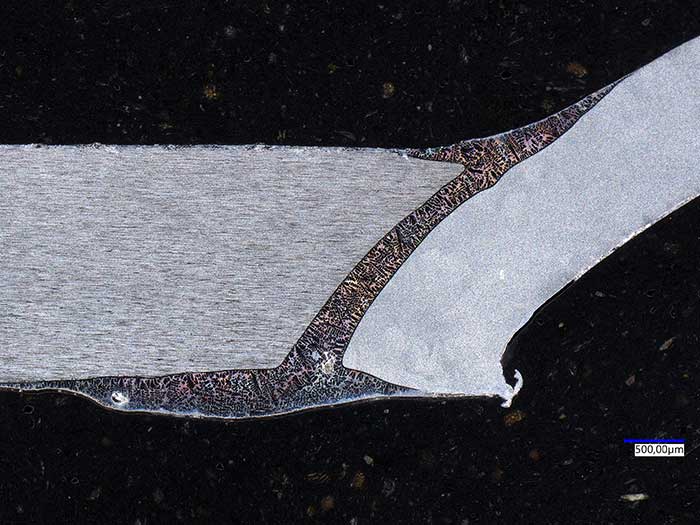
We evaluate the structural integrity of welded joints according to accredited standard UNI EN ISO 17639. This test reveals penetration depth, heat-affected zones (HAZ), and potential defects like inclusions or lack of fusion, providing essential data to certify the safety and reliability of critical junctions.
Fiber Flow in Forged Components
In accordance with the accredited standard UNI 3138, we analyze the grain flow (fiber orientation) in forged parts. Correct fiber alignment is fundamental to maximizing fatigue resistance and mechanical performance, ensuring that the forging process has optimized the material’s structural orientation for its intended use.